Authoritative Design Blueprints
To minimize technical and cognitive debt in an agentic development workflow, teams need to stay on top of their system's design. Intent Architect's visual modeling tools enable living design blueprints: the design is defined visually, in a model-centric way, with a bidirectional relationship between the models and the code. The models therefore always represent the current, living state of the design as agents build out your codebase, and model-centric diffs let you stay on top of design changes and the design decisions agents are making as they happen.
Key Benefits
📋 Stay on top of your design to minimize technical and cognitive debt
As agents write more and more code, it's becoming harder for developers to stay on top of their system's design and in control of technical and cognitive debt. Intent Architect's extensible designers give you an aggregated, model-centric view of your system's design that's easy to comprehend and always true to the underlying codebase, so you stay on top of the system's design at all times. In addition, model-centric diffs highlight codebase-related design changes as part of your code-review process, streamlining the validation and comprehension around this as agents evolve the system.
🗺️ Authoritative design blueprints bring design decisions to the forefront
The design and architecture are explicit and visible to the entire team, rather than implicit in the code. The blueprints generated in Intent Architect are living design specifications, that realize directly as code, and therefore always accurately represent what's implemented - agentically or otherwise. This means design and architectural decisions are better and made faster, changes are made with more confidence, and issues are resolved quicker.
⚡ A precise context engine for agents and guardrails
Design decisions are difficult to infer from code, which shows what was built but not which choices were intentional or what they were meant to enforce. In Intent Architect every design decision is captured in the model and stored as structured metadata alongside your source code, forming an always-current representation of intent that both AI agents and the deterministic guardrail system operate from. Agents execute against the design as modelled rather than as interpreted, and are provided with task context up front rather than inferring it from the codebase, so implementations conform to the approved design by default.
The Designers
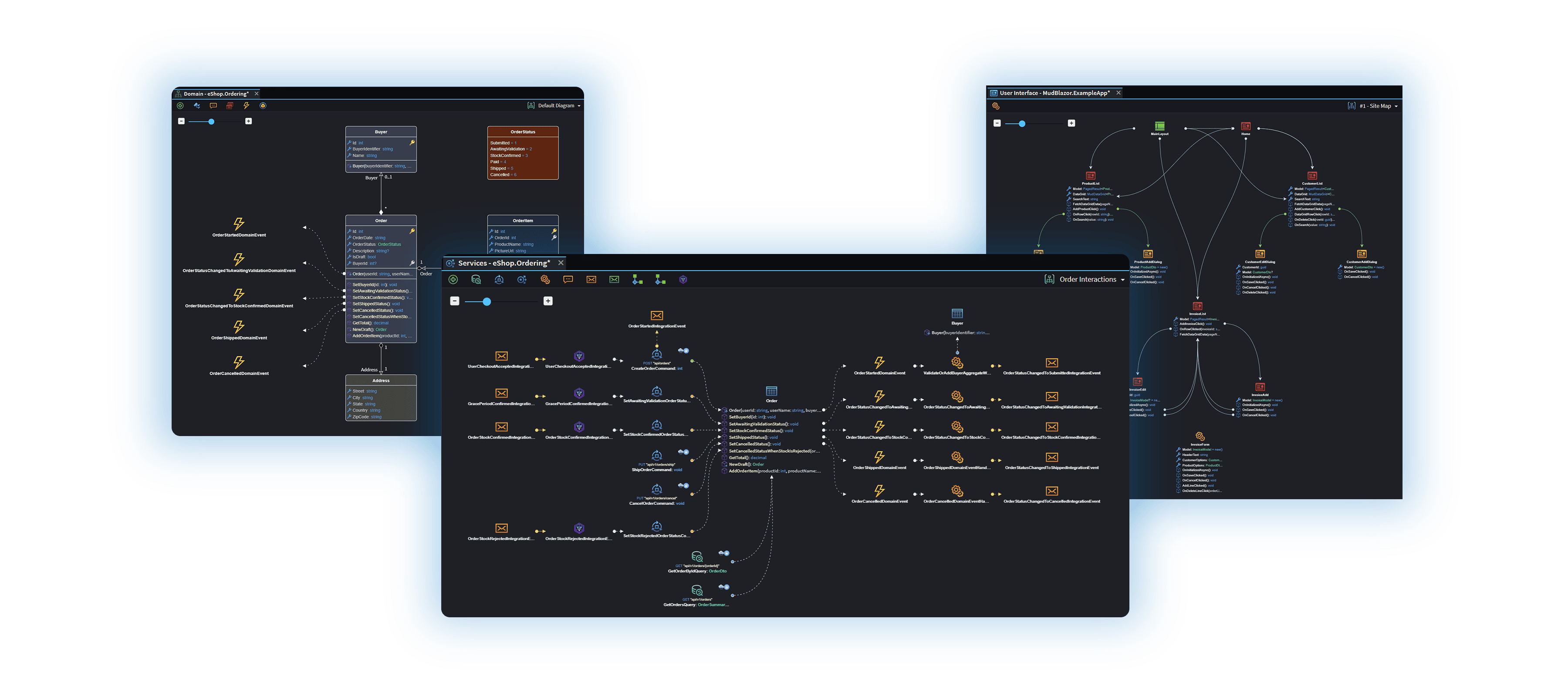
The Domain Designer lets you model your system's core entities, relationships, and data structures, the structural foundation from which your application is built. The Services Designer defines how your system behaves: use cases, contracts, and the integrations that connect your applications. The UI Designer captures user flows, screens, and data interactions from end to end.
Each designer targets a different layer of your architecture. Together, they give you a complete, structured picture of your entire system at any scale.
Designing with AI
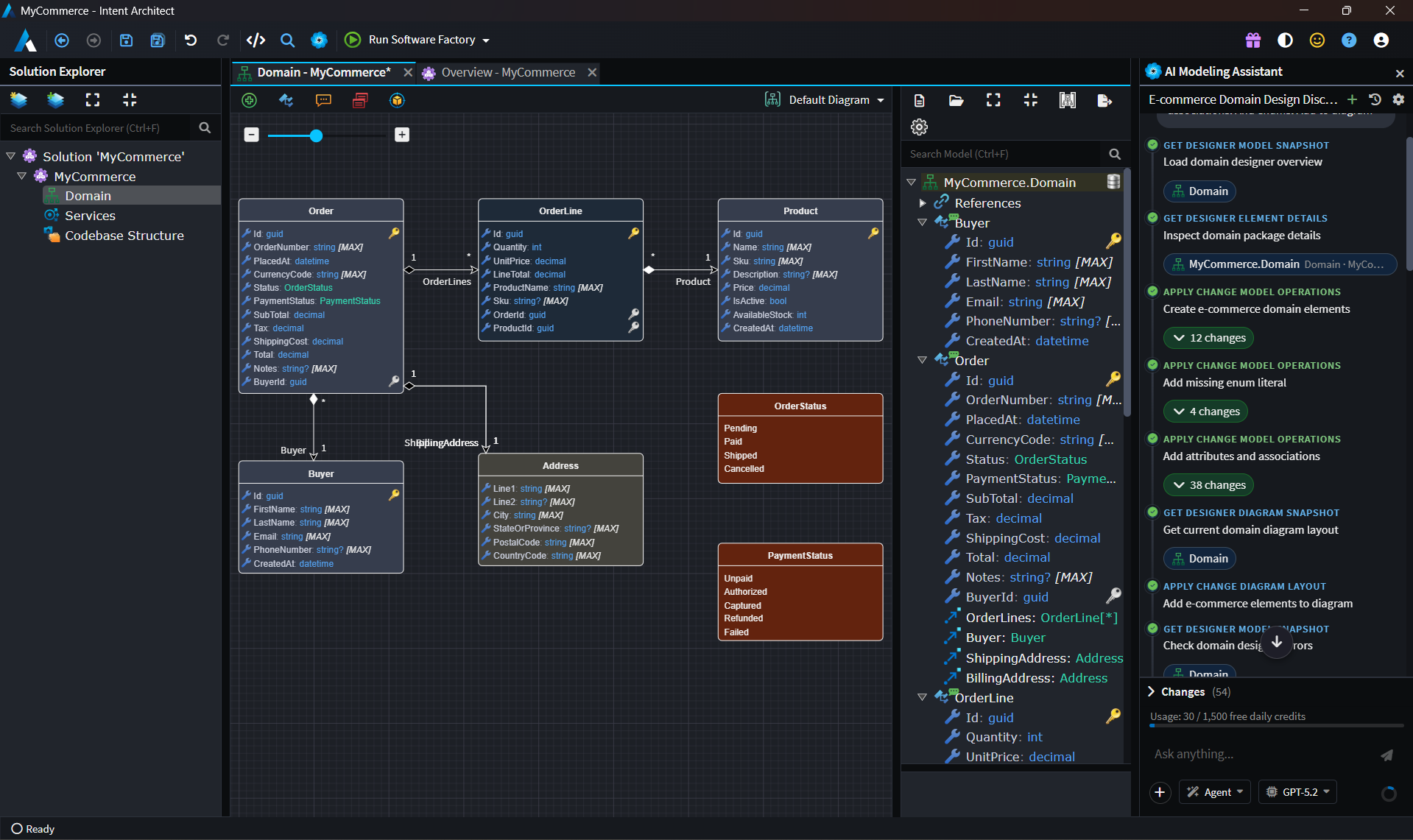
One of the most powerful ways to use the visual designers is with AI. Rather than building designs from scratch, you describe your requirements in natural language (or simply upload a specification) and the AI agent proposes the full design within the visual environment, entities, relationships, services, and more. All changes are made in memory and never saved without your explicit approval, so you stay in full control of every design decision.
The Context Engine
When you design in Intent Architect, every element you place, an entity, a service, a relationship, is saved as structured metadata alongside your source code. Collectively, this metadata forms the platform's context engine, a precise, always-current representation of your system's design intent.
This is what makes agentic development more reliable at scale. AI coding agents all generate code from this same structured source of truth. Rather than inferring design intent from code, which is imprecise and incomplete, every downstream system works from the exact design decisions you have made, visually, in the designers. Your intent is never lost in translation.
Living Documentation
Because designs are stored as structured metadata alongside your source code, they are always synchronized with your codebase, reflecting the current state of your system's design and architecture. New team members can explore the full system architecture visually rather than reverse-engineering it from thousands of lines of code, significantly accelerating the time it takes to validate/comprehend the current state of the system and contribute meaningfully.