Intent.VisualStudio.Projects
This module adds Visual Studio capabilities to the Codebase Structure Designer to allow applications to generate related files such as .sln and .csproj types.
Codebase Structure Designer Extensions
This module allows modelling of the following within the Codebase Structure Designer:
Visual Studio Solutions and its configuration.- The various C# projects that make up your solution and their configuration.
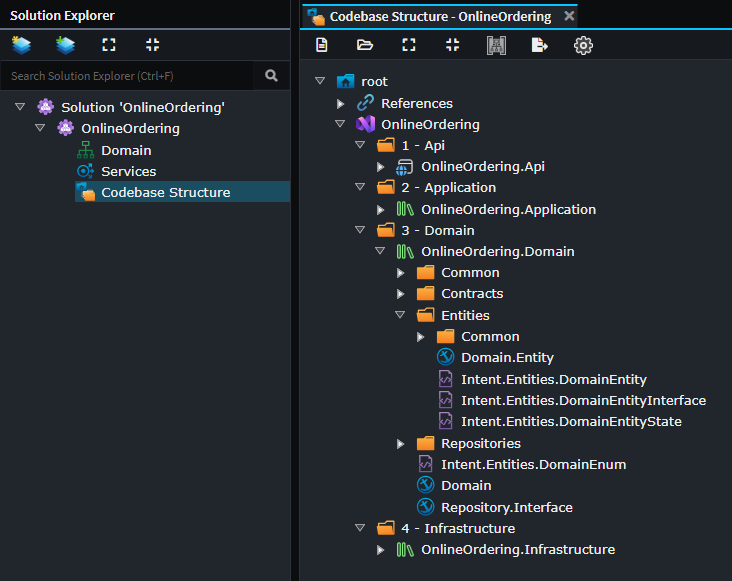
Below is an example of a Visual Studio Solution in the Codebase Structure Designer configured for a typical Clean Architecture application. We can see the following:
- The Visual Studio Solution will be named OnlineOrdering.
- The solution will have four C# projects:
- OnlineOrdering.Api – Responsible for application hosting and service distribution.
- OnlineOrdering.Application – Responsible for application-specific business rules and use cases.
- OnlineOrdering.Domain – Responsible for business rules and domain logic.
- OnlineOrdering.Infrastructure – Responsible for infrastructure, persistence, and integration.
We can also see Template Outputs, such as Intent.Entities.Entity, which indicate where the generated code files will be placed. In this case, domain Entity code files will be generated into the OnlineOrdering.Domain C# project, inside the Entities folder. When you install new modules, they will automatically add their Template Outputs to this designer. Modules use Output Anchors to determine where to place their Template Outputs.
Tip
Application Templates typically fully configure this layout for you. However, you can reconfigure or adjust this designer if you want to customize the structure of your application's code generation.
Adding a New Project
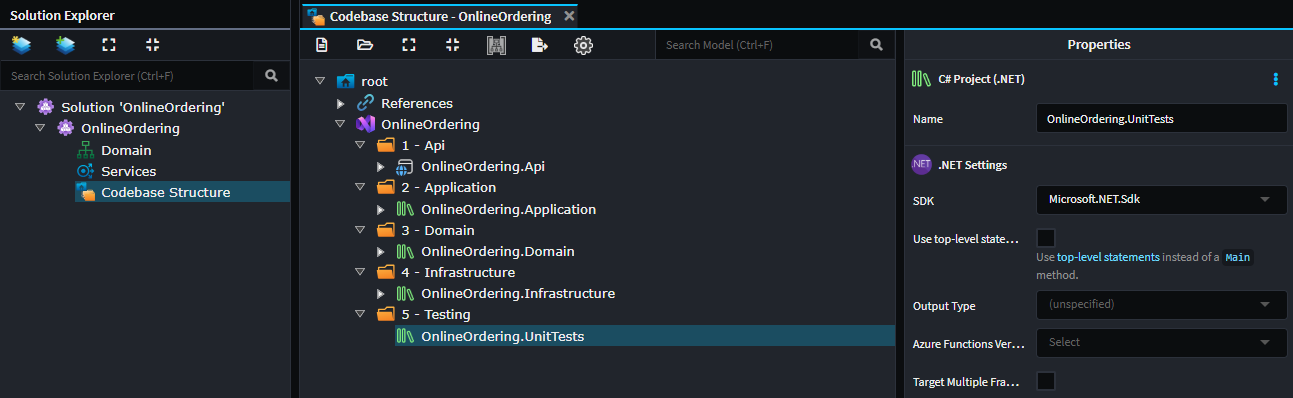
- Right-click on the
Visual Studio Solutionelement or aFolderunder it and selectC# Project (.NET). - Enter the name of your C# project.
- (Optional) Configure any project options in the Property Pane, such as
Target Framework. - (Optional) Customize your project by configuring
Output Anchors,Folders,Template Outputs, etc.
Customizing your Visual Studio Codebase Structure
If you want to change where Intent Architect generates code within Visual Studio solution and projects, you can do so by making changes in this designer. Here are some examples of how this can be achieved.
Moving a File to a Different Location
Given the following setup:
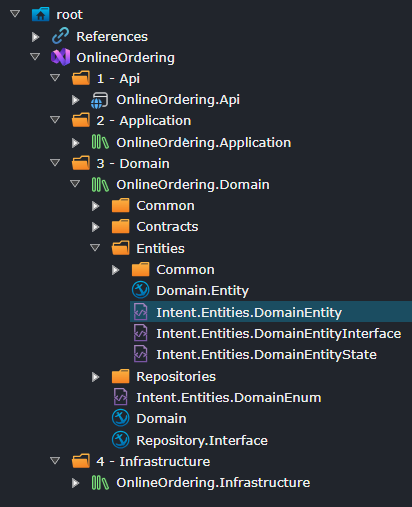
Modeled domain entities are generated into the Entities folder. These entities may be things like Customer or Order, depending on what Entitys you have modeled in the Domain Designer.
If you drag the Intent.Entities.Entity Template Output to the root folder of the C# project, the entities will now be generated directly into the project's root folder.
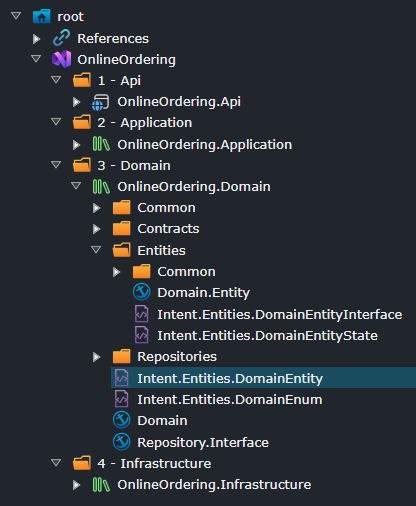
Alternatively, you could create a new folder, say My Folder, and move Intent.Entities.Entity into that folder. Now, the entities will be generated into a folder named My Folder.
Restructuring Projects
You can reorganize your Visual Studio solution structure by consolidating projects, splitting them apart, or creating entirely new projects. This section demonstrates common restructuring scenarios.
Consolidating Projects
In this example, let's assume you do not want four projects and prefer to consolidate the Application and Domain projects.
To consolidate the Domain project into the Application project:
- Move all
Template Outputs from theDomainproject into theApplicationproject, placing them where you want the code to go. - Delete the
Domainproject.
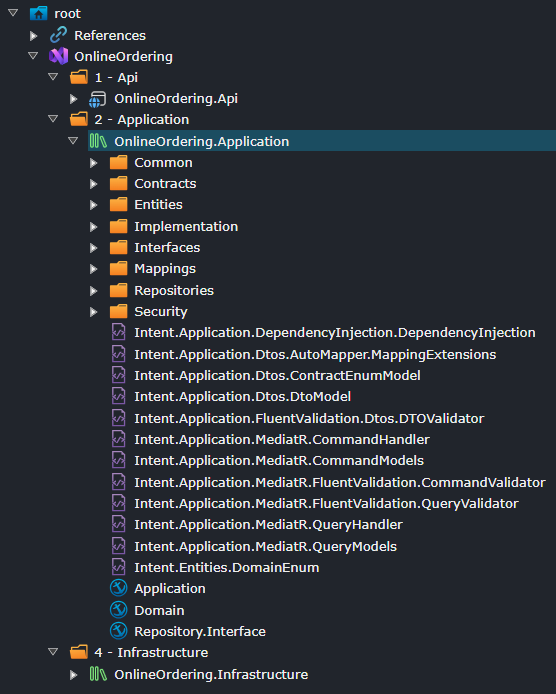
Visual Studio solution with Domain project consolidated into Application project.
Now, your Visual Studio solution will have three projects instead of four.
Adding Projects
In this example, we have a Standalone Blazor application, and we don't want HTTP Client information in our Client application but would prefer to split it out into its own project.
The existing structure of the solution. In this example, we want to move the Intent.Blazor.HttpClients.ServiceContract template to a separate project.
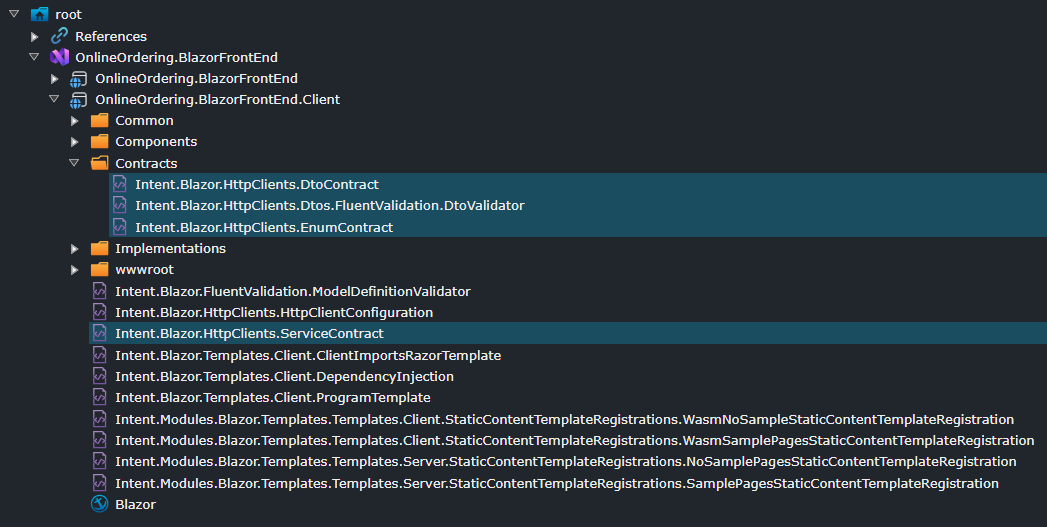
Original Blazor project structure with the ServiceContract template in the main Client project.
To split out templates into a separate project:
- Create a new project, as per the steps described in the Add a New Project section.
- Move the
Intent.Blazor.HttpClients.ServiceContracttemplate from the existing project to the new project, placing it where you want the code to go.
Warning
Templates that Intent.Blazor.HttpClients.ServiceContract depends on also need to be moved to avoid circular dependencies. The Software Factory will throw errors if projects have circular references.
- Move dependent templates to the new project. In this example, the entire
Contractsfolder also needs to be moved to the new project to prevent the Client project from depending on the New project while the New project depends on the Client project.
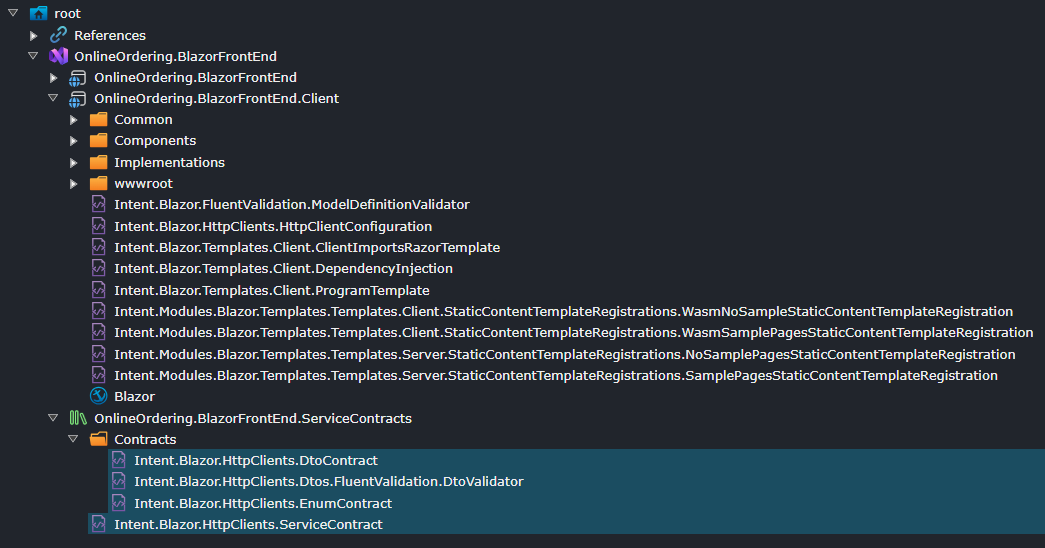
Refactored structure with HttpClients in a separate project.
Folder Options
Namespace Provider
The Namespace Provider option controls whether a folder's name contributes to generated code namespaces.
- Enabled: The folder name is included in the namespace.
- Disabled: Files are still generated into the folder, but the folder name is excluded from the namespace.
This is useful when you want to organize files on disk without forcing that structure into your code namespaces.
For example, if Orders is marked as a namespace provider and Internal is not, a class in Orders/Internal would use a namespace like MyApp.Orders (not MyApp.Orders.Internal).
This option is available on folders in all designers. Configure it in the designer where the folder is modeled to control which parts of the folder hierarchy participate in namespaces.
NuGet Package Management
This module is what installs NuGet packages into .csproj files. Other modules do not write package references themselves, instead their templates declare the packages the generated code depends on along with the minimum version required for it to compile and behave correctly. On each Software Factory execution, this module collects those declarations for each project and applies them.
How the installed version is determined
For each package a module has requested for a project:
- Not referenced in the project - the package is added at the requested version.
- Referenced at an older version - the version is upgraded to the requested version.
- Referenced at the requested version or a newer one - the reference is left as it is, packages are never downgraded.
Where several modules request the same package for a project, the highest of the requested versions is the one which gets installed.
Package references which no module requests are left alone, so packages which you added to the .csproj yourself are not modified. A package is only removed when a module explicitly requests its removal.
Note
When a requested package is already a transitive dependency of another requested package at an equal or higher version, it is not added as an explicit PackageReference, unless the project already references it.
Preventing a package from being changed
Adding an IntentIgnore="true" attribute to a PackageReference will cause this module to skip that package for that project, so its version will not be upgraded and the reference will not be removed:
<ItemGroup>
    <PackageReference IntentIgnore="true" Include="Microsoft.EntityFrameworkCore" Version="8.0.21" />
</ItemGroup>
Warning
Because the minimum version is no longer applied to an ignored reference, pinning a version lower than an installed module requires may result in generated code which does not compile.
Ordering and comments
PackageReferences in an ItemGroup that holds nothing else are kept in alphabetical order, and so are the Using items this module adds for the project's custom implicit usings. A group that is already in order is left exactly as it is.
Comments you write in these groups stay with the item they describe when it moves: a comment on the line(s) above an item, and a comment at the end of the item's own line. A comment after the last item stays at the end of the group. When a package is no longer requested and its PackageReference is removed, a comment above it is kept, and so is the ItemGroup holding it.
<ItemGroup>
    <PackageReference Include="Azure.Identity" Version="1.13.0" />
    <!-- Pinned: 9.x breaks our custom converters, see #412 -->
    <PackageReference Include="Newtonsoft.Json" Version="13.0.3" />
    <PackageReference Include="Serilog" Version="4.0.0" /> <!-- keep in step with Serilog.Sinks.* -->
</ItemGroup>
Note
For SDK-style projects, all of the above holds. For .NET Framework projects using PackageReference, and for Using items, the file is re-indented whenever Intent changes it, so a comment at the end of an item's line moves to its own line just below that item.
Module settings
| Setting | Default | Description |
|---|---|---|
| Consolidate Package Versions | false |
When enabled, versions of a NuGet package are consolidated across the solution to be the same as the highest currently installed version. |
| Warn On Multiple Versions of Same Package | true |
When enabled, warnings are shown if multiple versions of the same NuGet package are installed within the solution. Only applicable when Consolidate Package Versions is disabled. |
Note
In applications which have the Intent.ModuleBuilder module installed, its Dependency version overwrite behavior setting also applies to NuGet packages, allowing the default upgrade behaviour described above (If newer) to be changed to Always or Never.
Launch Settings
For projects with Generate LaunchSettings File enabled on the .NET Settings stereotype, this module generates Properties/launchSettings.json, including launch profiles and environment variables which other modules register (e.g. a Docker profile). Generate LaunchSettings File is on by default for Web, Worker and Blazor WebAssembly projects (see Generate AppSettings File and Generate LaunchSettings File).
Once the file exists, it is only ever added to:
- A registered profile is appended when no profile with that name exists. A profile which already exists is never changed.
- A registered environment variable is added to a profile which does not have it. Existing values are never changed.
- When an HTTP endpoint is required (e.g. Enable HTTPS Redirect is disabled),
http://localhost:{port}is added to anapplicationUrlwhich only hashttps://entries. - On
*.Apiprofiles, alaunchUrlpointing atswaggerorscalar/v1is updated when you switch between Swashbuckle and Scalar. Any otherlaunchUrlis left as you set it.
Everything else in the file is preserved as written, including $schema, property order, unrecognized properties and commandName values, indentation, line endings, and the trailing newline. When nothing needs adding, the file is left untouched.
App Settings
For projects with Generate AppSettings File enabled on the .NET Settings stereotype, this module generates appsettings.json (and appsettings.{Environment}.json for each modelled runtime environment), adding the settings and connection strings which other modules register.
An existing file is only ever added to: a setting that is already present keeps its value. When nothing needs adding, the file is left byte-for-byte as it is. When something is added, the file keeps its own indentation, line endings and comments, and date- and number-like values are kept exactly as written.
A new file is indented according to the .editorconfig that applies to it, honouring only the [*] section and sections whose glob matches the file (e.g. [*.json]), so a [*.cs] indent_size does not reach JSON files. Without one, it is indented with 2 spaces.
Stereotype details
The .NET Settings stereotype
The SDK property
Sets the Sdk attribute of the .csproj file. Besides the Microsoft.NET.Sdk.* SDKs, Aspire.AppHost.Sdk (written with its Aspire SDK Version) and MSTest.Sdk are available.
For MSTest.Sdk, the optional MSTest SDK Version property is written as Sdk="MSTest.Sdk/{version}". Leave it empty to resolve the version from global.json ("msbuild-sdks": { "MSTest.Sdk": "4.0.2" }). An empty value also keeps any version already in the .csproj.
When the existing .csproj uses an SDK that isn't one of these options (e.g. Microsoft.Build.NoTargets/3.7.0 or Uno.Sdk), its Sdk attribute is never changed, whatever the model says. An SDK which is one of the options is always made to match the model. For example, an MSTest.Sdk project modelled as Microsoft.NET.Sdk is rewritten to Microsoft.NET.Sdk.
Target frameworks
The Target Framework / Target Frameworks properties set the .csproj file's <TargetFramework> / <TargetFrameworks>. An existing value is only rewritten when it is a single, unconditional element holding plain monikers (e.g. net8.0) whose set differs from the model. It is left untouched when:
- there is more than one
TargetFramework/TargetFrameworkselement, or aConditionon the element or itsPropertyGroup, or the value uses an MSBuild property ($(...)); - it holds the same frameworks as the model, in any order;
- it holds platform-specific frameworks (e.g.
net10.0-android;net10.0-ios) which reduce to the modelled framework.
The model can't represent platform-specific frameworks. When those of a multi-platform project (e.g. .NET MAUI) no longer match the model, the .csproj is left untouched and the Software Factory logs a warning naming the project, so the change has to be made by hand.
Generate AppSettings File and Generate LaunchSettings File
These control whether this module manages the project's appsettings.json (see App Settings) and Properties/launchSettings.json (see Launch Settings). They are available for Microsoft.NET.Sdk, Web, Worker and Blazor WebAssembly projects:
- Web, Worker and Blazor WebAssembly projects: turning a flag off makes Intent hands-off for that file: an existing file and its
.csprojitems (e.g.<Content Include="appsettings.json">) are left exactly as they are (never rewritten, added or deleted), none is created, and settings, launch profiles or ports which other modules request for the project are not written. The Software Factory log lists what was not written. Microsoft.NET.Sdkprojects default to off. With Generate AppSettings File off, settings registered for the project are handled by the host projects that reference it.
When this module is installed, or upgraded from an earlier version, both flags are turned on for the application's existing Web, Worker and Blazor WebAssembly projects, which always had both files generated. From then on, the flags are whatever you set them to.
The Suppress Warnings property
Adds a <NoWarn /> element to the .csproj file with the specified value of semi-colon separated codes of warnings to suppress.
By default, this is populated with the value $(NoWarn) which will apply the default suppressed warnings. While this value is set to $(NoWarn), no <NoWarn /> element will be added to the .csproj file.
;1561 is automatically appended by some Intent Architect application templates to suppress the Missing XML comment for publicly visible type or member 'Type_or_Member' warning.
Use top-level statements
When enabled the Program.cs will no longer generate a class and instead use top-level statements.
Note
Requires at least version 6.0.0 of the Intent.Modules.AspNetCore to be installed in order for changes to take effect.
Worker projects' Program.cs
For Microsoft.NET.Sdk.Worker projects, this module generates Program.cs with [assembly: DefaultIntentManaged(Mode.Merge)], so statements you add are kept. Use top-level statements decides between top-level statements and a Main method: set it to match an existing Program.cs, since switching an existing file between the two styles isn't supported.
When Program.cs already exists, the template adapts to it rather than adding statements that duplicate yours:
- Its builder declaration is kept as written:
var builder = WebApplication.CreateBuilder(args);orHost.CreateApplicationBuilder(args)(generated asHostApplicationBuilder builder = Host.CreateApplicationBuilder(args);for a new file). - Its run call is kept:
app.Run();, orawait app.RunAsync();, in which case a generatedMainmethod isasync Task.
With top-level statements, using {project namespace}; is only added when Intent generates types in that namespace (or a namespace nested under it), so a project whose code lives under a different root namespace still compiles.
An existing Program.cs in any other shape is left untouched, and the Software Factory logs a warning. This includes Host.CreateDefaultBuilder(args).ConfigureServices(...), different variable names than builder and app, or more than one run call. Startup code that other modules add to Program.cs (e.g. Serilog or Windows Service hosting) is then not applied.
The logging settings a Main-method Worker adds (Logging:EventLog:*) are written to that project's own appsettings.json only.
Generate Program File
Generate Program File on the .NET Settings stereotype is shown only for Microsoft.NET.Sdk.Worker projects, and is on by default. Turning it off makes Intent hands-off for Program.cs: an existing file is left exactly as it is, none is created, and startup code that other modules add to Program.cs (e.g. Serilog or Windows Service hosting), along with the Logging:EventLog:* settings above, is not applied. The Software Factory logs this for each such project.
Worker projects created before this setting existed have no value for it, and are treated as on, so they keep generating Program.cs.
Use minimal hosting model
When enabled Startup.cs will no longer be generated, and all start-up will be performed in Program.cs by of the new minimal hosting model introduced with .NET 6.
Note
Requires at least version 6.0.0 of the Intent.Modules.AspNetCore to be installed in order for changes to take effect.
The Output Type property
Sets the <OutputType /> element in the .csproj file (Class Library, Console Application, or Windows Application, mapped to Library, Exe, and WinExe respectively). Leave it unset to fall back to the SDK's own default.
This property is settable regardless of the selected SDK, including Aspire.AppHost.Sdk. An Aspire AppHost project must build as an executable to run as the orchestrator, so leave it unset (the Aspire SDK defaults it to Exe) or set it to Console Application explicitly — Class Library and Windows Application will produce a non-runnable AppHost.
The Visual Studio Solution Options stereotype
This stereotype is applied to Visual Studio Solution elements.
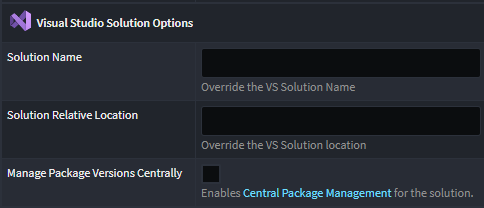
Solution Name
By default, your Visual Studio Solution name will be the same as your Visual Studio Package name. These properties allow you to explicitly specify the name without changing the package name. This is useful for scenarios where you have a shared VS Solution across Applications.
Solution Relative Location
By Default, your Visual Studio Solution will be placed in Application's Relative Output Location, this setting allows you to adjust the location of the solution relative to it's default location. Project references inside the generated .sln/.slnx are automatically kept correct relative to wherever this setting places the file.
Solution File Format
Controls which solution file format is generated for this Visual Studio Solution. Two options are available:
- Classic (.sln) (default): Generates the traditional
.slnformat that all Visual Studio versions support. - XML Solution (.slnx): Generates the modern XML-based
.slnxformat introduced in Visual Studio 2022 and .NET 10. It is simpler to read and diff — no GUIDs. Intent itself does not generate solution configurations/platforms or per-project build type mappings into this file, but if you or Visual Studio add them directly to the.slnx— along with any other manual customisation such asBuildDependency,Properties, or comments — the Software Factory preserves them on every subsequent run; they are only ever changed when the project or folder they belong to is itself renamed, moved, or removed.
To switch formats, apply the Visual Studio Solution Options stereotype to the solution element and change the Solution File Format property. When you run the Software Factory after switching, it will generate the new format and present the removal of the old file in the staged changes view.
Note
The .slnx format requires Visual Studio 2022 17.10 or later, or the .NET 10 SDK.
The Root Folder Options stereotype
This stereotype is applied to the Root Folder element (shown as root at the top of the Codebase Structure Designer) and is owned by the Intent.Modelers.CodebaseStructure module. Its Relative Location property lets you shift the application's absolute output root (OutputRootDirectory) so that the .sln/.slnx file, .gitignore, and a centrally-managed Directory.Packages.props can be generated one or more levels up from the application's own output location, in a folder shared with sibling applications.
See the Root Folder Options stereotype section of the Intent.Modelers.CodebaseStructure module's documentation for the full property details, an example, and known caveats (including an Intent.Modules.SharedKernel.Consumer interaction).
The Folder Options stereotype
This stereotype is applied to Solution Folder elements.
Materialize Folder
When checked, this option will materialize your logical Visual Studio Solution folders as actual folders on disk.
Projects under a materialized folder are written to an .slnx file the way dotnet sln add writes them (e.g. src/Basket.API/Basket.API.csproj). Paths are compared after normalisation, so an existing entry written as src/... or ./src/... is matched and kept exactly as written.
Adopting an existing (brownfield) repository
When modelling projects that already exist on disk, model them to match the repository so that the Software Factory leaves existing files alone:
- Turn on Materialize Folder for solution folders that are folders on disk (e.g.
src,tests). - Set SDK to what each
.csprojuses, includingMSTest.Sdkfor MSTest projects. Leave MSTest SDK Version empty whenglobal.jsonsupplies it. - Set Target Framework to each project's base framework (e.g.
net10.0for a .NET MAUI app targetingnet10.0-android;net10.0-ios). - Set Use top-level statements to match each Worker project's existing
Program.cs. - Untick Generate AppSettings File and Generate LaunchSettings File on Web, Worker and Blazor WebAssembly projects whose
appsettings.jsonandlaunchSettings.jsonshould stay hands-off. - Untick Generate Program File on Worker projects whose
Program.csshould stay hands-off.
Central Package Management
In .NET, Central Package Management (CPM) allows management of NuGet package versions for multiple .csproj from a central Directory.Packages.props file and an MSBuild property.
To have Intent Architect automatically create and manage a Directory.Packages.props file for a solution, on the Visual Studio Solution Options stereotype, check the Manage Package Versions Centrally property.
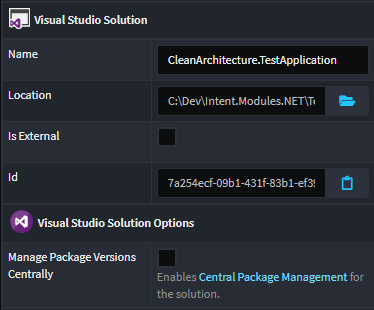
Once enabled, PackageReference items .csproj files will by default no longer add a Version attributes added to them and any existing ones will be removed.
Once Manage Package Versions Centrally is enabled, several options become available to control where the Directory.Packages.props file is output.
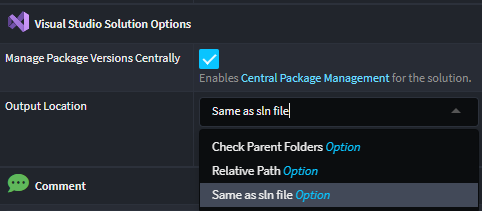
Available Output Location Options
Same as .sln file (default):
TheDirectory.Packages.propsfile will be placed in the same directory as the solution (.sln) file.Relative Path:
TheDirectory.Packages.propsfile will be placed at the specified relative path field value, which is resolved against the solution (.sln) file location.- Relative Path field:
This field is only available when the Output Location is set to Relative Path. For example, setting the value to../will result in the output folder being one folder higher than the solution file location.
- Relative Path field:
Check Parent Folders:
The system will check parent directories (starting from the solution file's location) for an existingDirectory.Packages.propsfile. If found, that file will be used; otherwise, a new one will be created in the solution (.sln) file's directory.- Only Check Current Git Repository (checkbox):
This option is available when Check Parent Folders is selected. If enabled, the search will stop at the root of the current Git repository (i.e., the first directory containing a.gitfolder).
- Only Check Current Git Repository (checkbox):
Managing Project Package Versions
It is also possible to control the behaviour of a single project by setting the Manage Package Versions property on its stereotype:
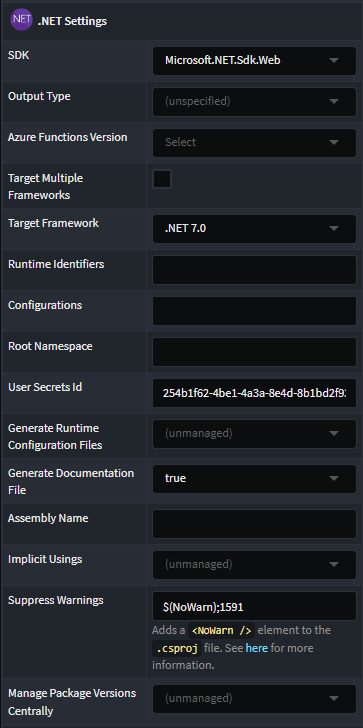
The following options are available:
(unmanaged) - Intent will not add, change or remove the
ManagePackageVersionsCentrallyproperty in the.csprojfile.(unspecified) - Intent will ensure there is no
ManagePackageVersionsCentrallyproperty in the.csprojfile removing it if necessary.Versionattributes will be added toPackageReferenceitems depending on whether the Solution has the CPM option set.false - Intent will ensure the
ManagePackageVersionsCentrallyproperty is present with a value offalseand regardless of the the Solution's CPM setting,Versionattributes will always be added toPackageReferenceitems.true - Intent will ensure the
ManagePackageVersionsCentrallyproperty is present with a value oftrueand regardless of the the Solution's CPM setting,Versionattributes will be removed fromPackageReferenceitems.
Note
Regardless of the project level's Manage Package Versions setting, unless the solution has Manage Package Versions Centrally set, Intent will not update or manage PackageVersion items for a Directory.Packages.props file.
Floating Package Versions
By default, NuGet's Central Package Management rejects a floating version (e.g. Version="8.0.*") on a PackageVersion entry - dotnet restore fails with NU1011: Centrally defined floating package versions are not allowed.
To allow floating versions, on the Visual Studio Solution Options stereotype, check the Central Package Floating Versions Enabled property (available once Manage Package Versions Centrally is checked). On the next Software Factory run, Directory.Packages.props gains a CentralPackageFloatingVersionsEnabled property set to true in the same PropertyGroup as ManagePackageVersionsCentrally:
<Project>

  <PropertyGroup>
    <ManagePackageVersionsCentrally>true</ManagePackageVersionsCentrally>
    <CentralPackageFloatingVersionsEnabled>true</CentralPackageFloatingVersionsEnabled>
  </PropertyGroup>

</Project>
Unchecking the property does not remove it once written - this avoids reverting a value you may have since changed by hand.
Warning
This property only makes a floating version legal to NuGet - it does not change how this module itself writes versions. A PackageVersion entry that no installed module requests (one you added by hand) keeps its float untouched. A PackageVersion entry that an installed module does request will still have its float rewritten to that module's pinned version, since the float's minimum version is what gets compared against the requested version. Setting the project's Dependency Version Overwrite Behavior module setting to Never (see Module settings above, requires Intent.ModuleBuilder) avoids this for module-requested packages too, since it only writes a version when the entry is absent.