What's new in Intent Architect (February 2026)
Welcome to the February edition of What’s New in Intent Architect.
Lot's of clients have been asking for it - in case you missed it, we recently shared that the team has been hard at work on our next front-end automation: Angular - a long-term milestone we’ve been looking forward to. The first release includes application setup, UI modeling, and AI-generated views.
- Highlights
- Integrated AI Assistant – An integrated AI assistant that answers questions about your workspace, analyzes designs, and helps evolve solutions.
- Angular UI Automation – Model your pages, routing and service interaction, then have Intent Architect’s deterministic code generation, combined with AI, to create the Angular app end to end.
- Synchronize code to design – Reverse-engineer code changes back into your Intent Architect design.
- Synchronize with Domain Entity – Keep Commands, Queries, and Service Operations aligned with their corresponding Domain Entities by automatically detecting and applying structural changes.
- Aggregate Association Mapping via IDs – Easily link Entities to related Aggregate Root Entities in Create and Update actions using just their IDs.
Update details
Integrated AI Assistant
The new Integrated AI Assistant feature provides an in-product assistant to help developers understand and evolve their solution design. It has access to the entire Intent Architect documentation site, and several powerful tools to access and modify the existing design of the systems.
Developers can use it to answer questions about the current workspace, explain how existing elements fit together, and propose design changes to meet new requirements. The assistant can also inspect models and diagrams to summarize structure, highlight dependencies, and identify gaps or inconsistencies.
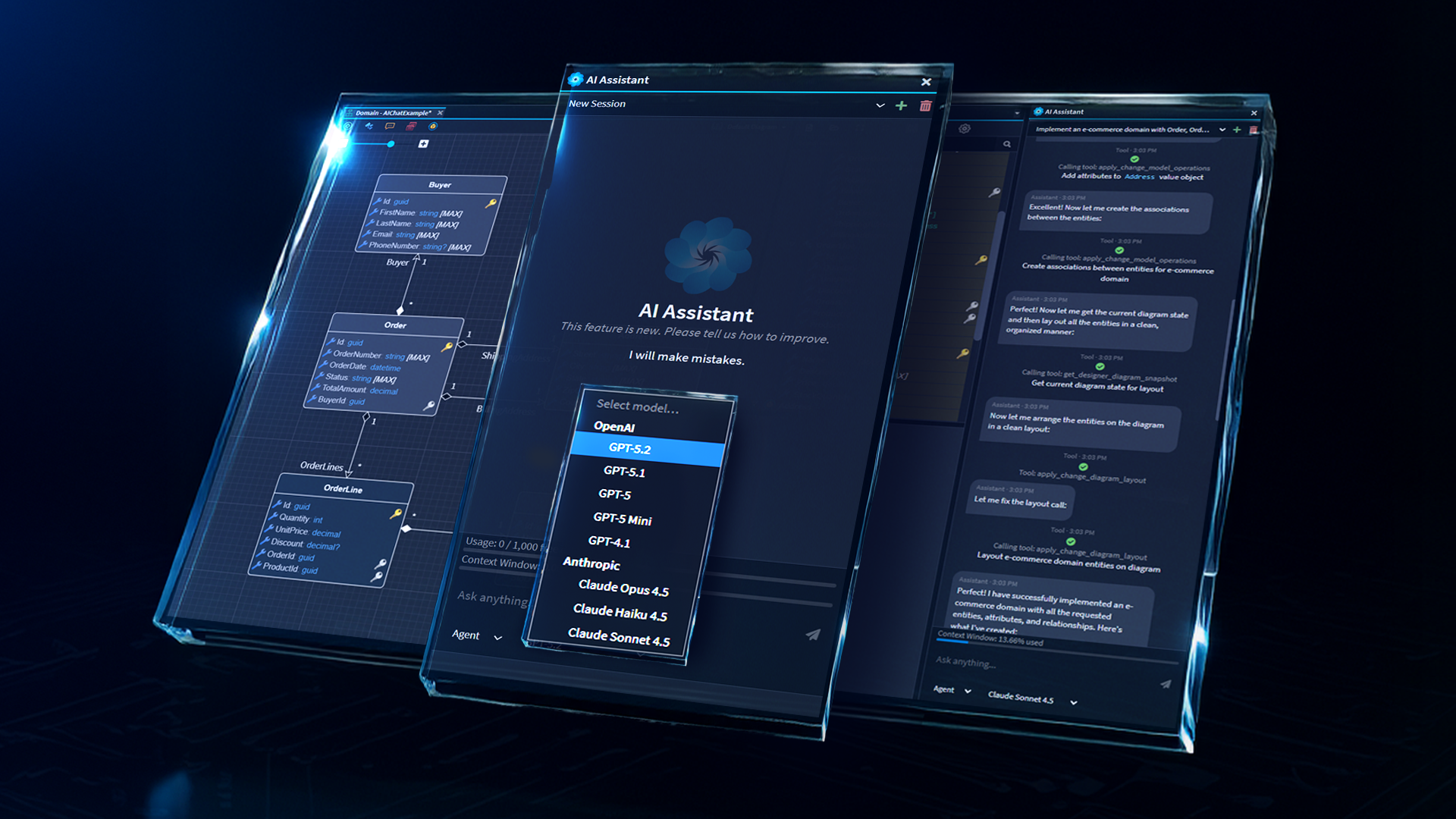
Full details in the release notes.
- Intent Architect 4.6.0-beta.*
Angular UI Automation
A new Angular Web Application template is now available (currently in Beta) when creating a new application. Define your components, along with their interactions, navigation, and models, and have Intent Architect generate deterministic typescript code. You can then leverage Intent Architect’s AI context engineering interactions to produce professional, out-of-the-box UI and styling in a repeatable (though non-deterministic) way, which you can refine to suit your needs.
These AI interactions build their prompts using customizable templates, so you can tweak or extend them as your requirements evolve.
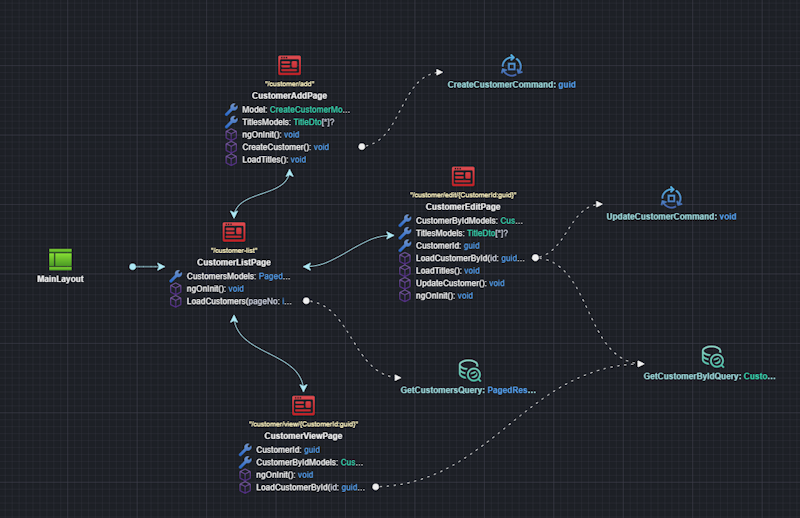 Modeling of sample customer CRUD pages
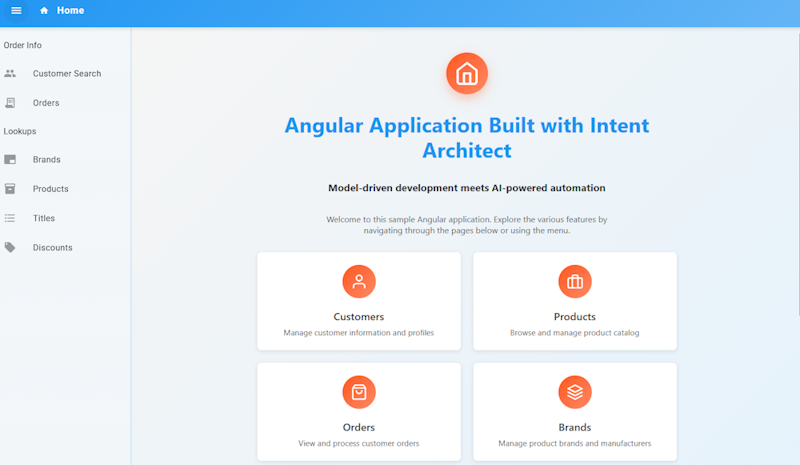 Generated Angular application
This feature is currently in beta, so while it’s already usable, there are some rough edges we’ll be smoothing out over time. If you’d like to try it early, we’d appreciate your feedback to help shape how this Angular module evolves.
An Angular sample application is also available from the Create New Solution -> Explore Samples screen in Intent Architect.
Documentation on Angular UI Modeling with AI is available on the docs website.
Synchronize code to design
A common request we've received is being able to take changes made to files in your IDE and have them imported back into Intent Architect, particularly for simple changes like the adding or changing of a property type.
The Software Factory will now offer this for templates which have had support added to them for this.
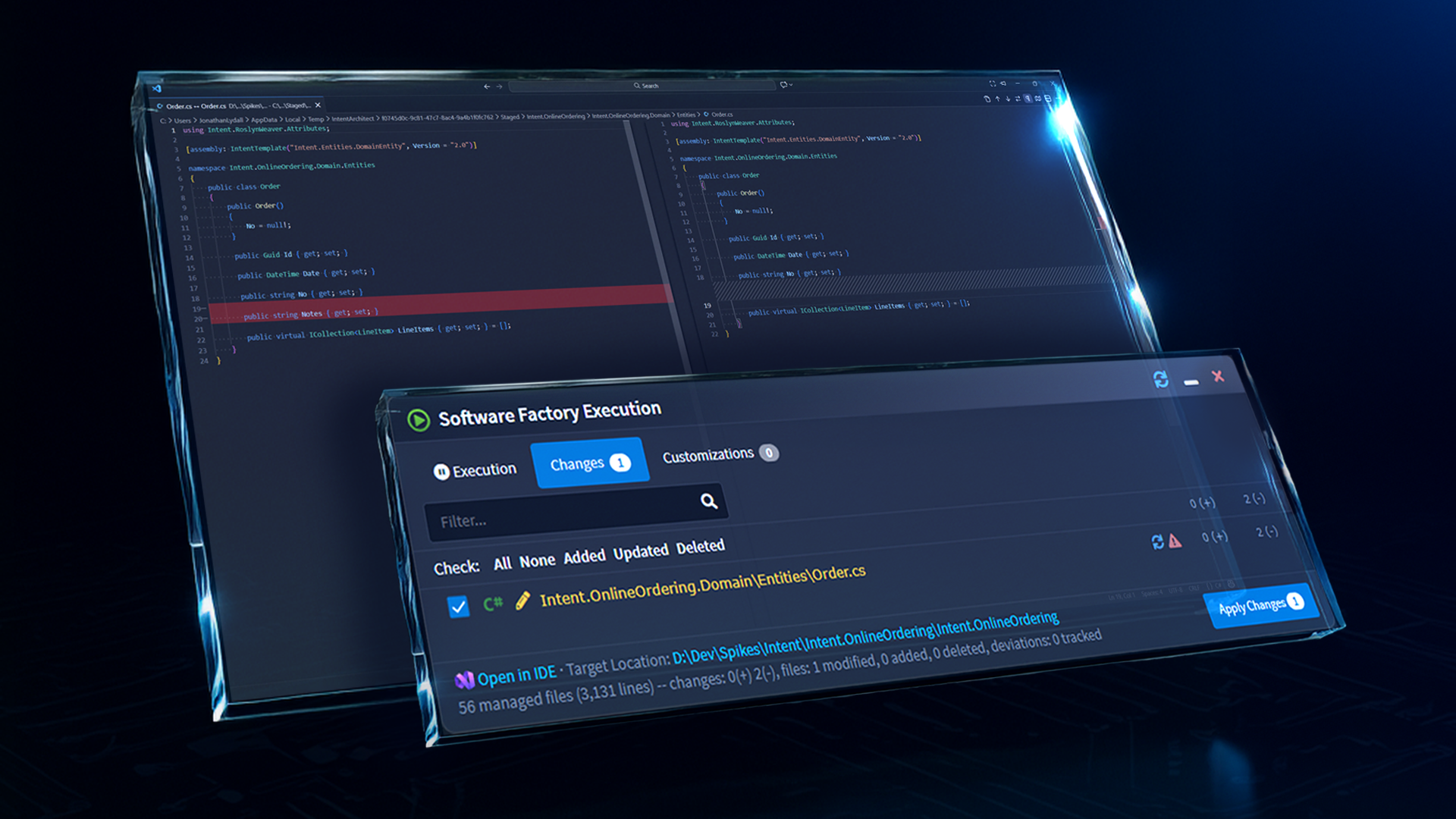
Full details in the Synchronize code to design article.
- Intent Architect 4.6.0-beta.*
- Intent.Application.Dtos 4.5.0-pre.2
- Intent.Entities 5.2.0-pre.3
Synchronize with Domain Entity
You can now keep Commands, Queries, and Service Operations aligned with their corresponding Domain Entities by automatically detecting and applying structural changes.
When structural differences are detected, the system presents a clear list of field discrepancies, such as renamed properties, added or removed fields, and data type changes. Developers can selectively choose which discrepancies to apply. Based on the selected items, the tool automatically updates the DTO structure and adjusts mappings to match the current shape of the target domain entity.
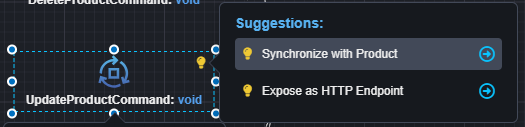
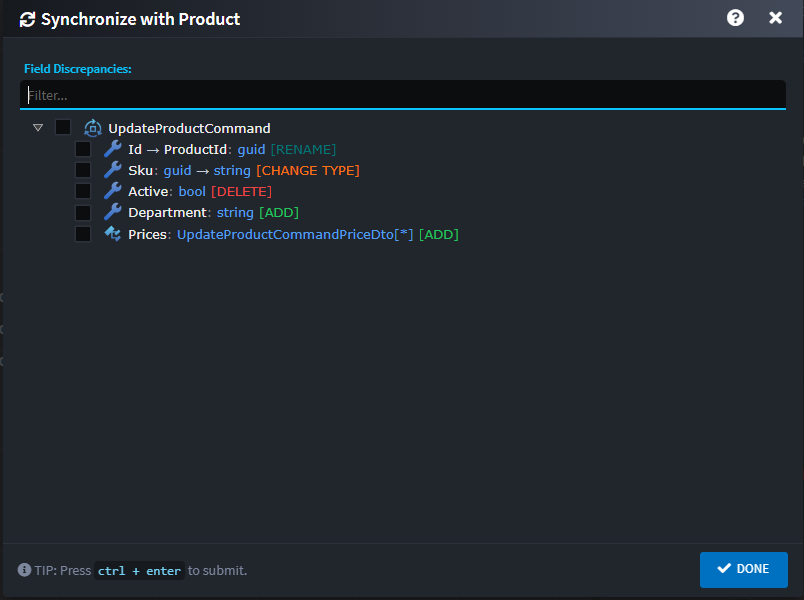
This approach reduces manual maintenance, prevents contract drift as domain models evolve, and ensures application boundaries remain consistent-while keeping all changes explicit, reviewable, and under developer control.
Available from:
- Intent.Modelers.Services.DomainInteractions 2.4.0-pre.1
- Intent Architect 4.6.0-beta.1
Aggregate Association Mapping via IDs
You can now define relationships to aggregate roots using their identifiers in Create and Update actions, rather than requiring full aggregate instances to be supplied by the caller.
Instead of mapping an entity’s aggregate associations directly, commands expose Aggregate Association Ends (for example, CategoryIds) that represent references to existing aggregate roots. During command handling, these identifiers are automatically resolved into aggregate instances through their appropriate repositories and assigned to the target entity before persistence.
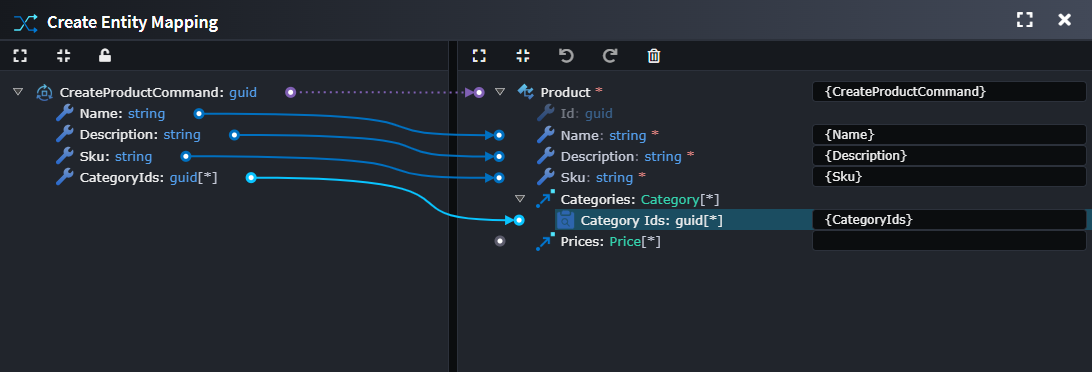
Example of mapping Aggregate Entities by ID.
var existingCategories = await _categoryRepository.FindByIdsAsync(
    request.CategoryIds.ToArray(),
    cancellationToken);

var product = new Product
{
    Name = request.Name,
    Description = request.Description,
    Sku = request.Sku,
    Categories = existingCategories
};

_productRepository.Add(product);
Generated code example.
Available from:
- Intent.Application.DomainInteractions 1.1.10