Intent-based Review Systems
When agents do the coding, validation becomes the new delivery bottleneck – teams either slow down to review properly, or rely purely on tests and agentic reviews/suggestions and push risk downstream. Intent Architect's Change Review system adds a deterministic review layer to both, so teams can review intent instead of lines of code and not rely on tests and agentic reviews alone. Spec diffs show behavioral changes, model-centric diffs show design and architectural changes, and risk classification lets teams zone their codebase and review only the most important files and changes. Combined with an AI-driven review and healing pass, teams can review quickly and effectively at the volume and speed of agentic coding.
Key benefits
🔍 Streamline validation processes and stay in control as review volume grows
Code reviews stay efficient, effective and manageable as the volume of agent-written code grows. Intent Architect's Change Review tool hooks into your team's preferred PR platform – GitHub, Azure DevOps, GitLab, Bitbucket etc. – to focus, optimize and denoise the pull request process. So teams sustain review discipline and remain accountable at any scale of agentic coding.
🎯 Review effort goes to the changes that matter
The most important and high-impact changes are prioritized as PR size grows. Change Review combines a comprehensive AI-driven review and healing pass with deterministically-driven severity classification and model-centric diffs, so developers see what changed, how much it matters, and what it means for the design. So teams review quickly and effectively at the same time.
🔗 Establish the why behind every change
Changes remain connected to the requirements and specifications that drove them. Change Review surfaces the traceability links on a change and answers the why, so reviewers can establish what it is for and where it came from as part of the review or PR. So teams stay accountable at a requirements level as they scale agentic coding.
Change Review
Change Review is a code review system built for agentic development, where the volume of change is amplified beyond what conventional review processes can practically handle. It is a central place to optimize and review all codebase changes, whether deterministically generated or written by agents (or developers).
It hooks into your team's preferred PR platform – GitHub, Azure DevOps, GitLab, Bitbucket etc. – and denoises the pull request process through five components. An AI review and healing system finds and corrects issues across the change. Deterministically-driven severity classification flags what carries risk, so review effort goes to what matters most. Spec diffs show what a change means for the system's behavior. Model-centric diffs show what a change means for the design, not just the code. And traceability links surface the requirements and specifications behind a change, so reviewers can establish why it exists.
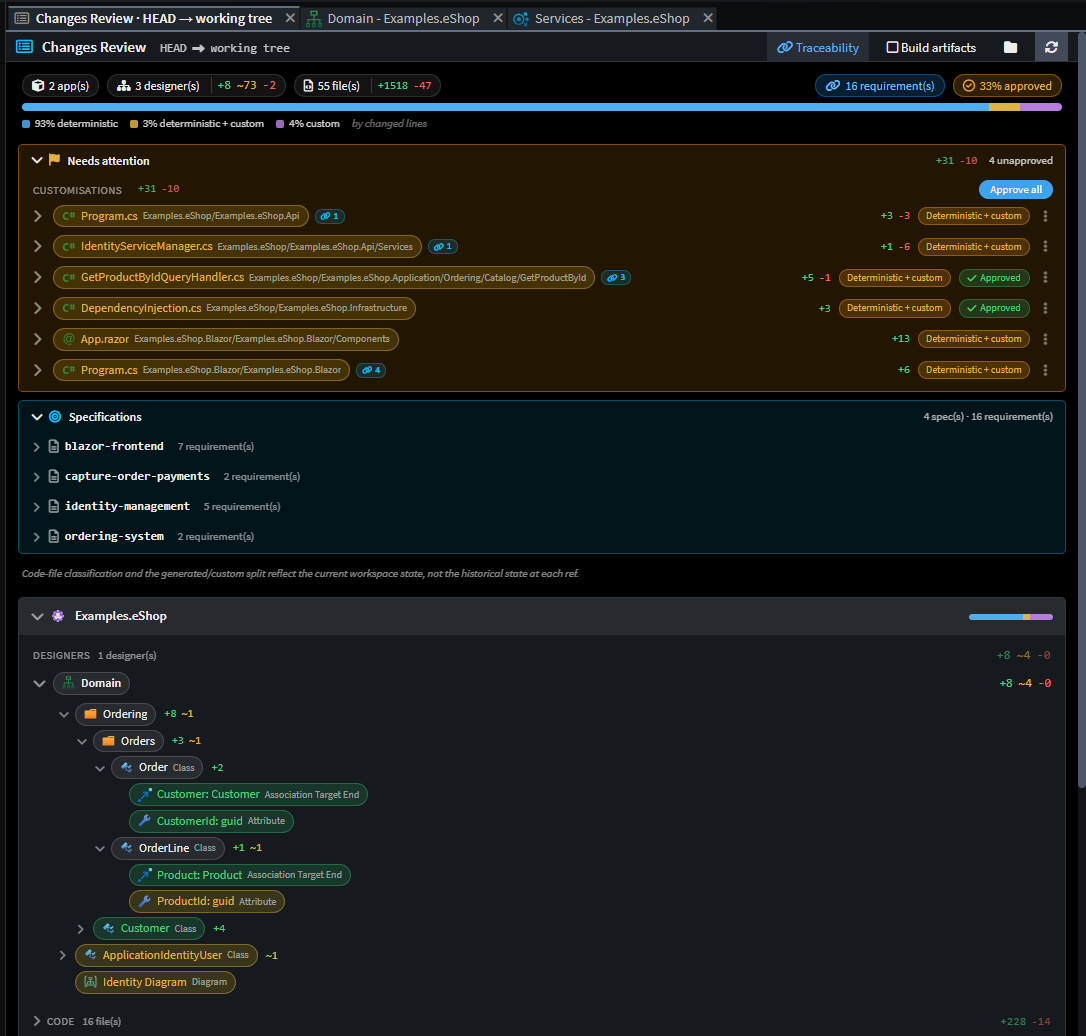 An example of the Change Review for the working tree against the Git HEAD.
AI Review and Healing
An AI review runs directly on a pull request, over its actual merge-base to head range, using the same review engine as Change Review. Findings land as a pending review draft rather than being posted one at a time, so you read, edit or drop each one and submit the whole review yourself. Where a finding can be corrected, the agent can heal it – detecting the drift and fixing it rather than only flagging it.
A re-run skips anything already flagged, including on threads that have since been resolved, so repeated reviews do not accumulate duplicate comments.
Severity Classification and Model-Centric Diffs
Deviations and custom files are tagged with colour-coded File Classification elements and a severity flag – none, low, medium or high. Classification is checked against git-classified file operations and canonicalized file paths, using the same logic Change Review itself uses, so severity reflects what actually changed rather than what an agent reported. A Needs Attention filter surfaces files by severity and classification, based on your bespoke configuration.
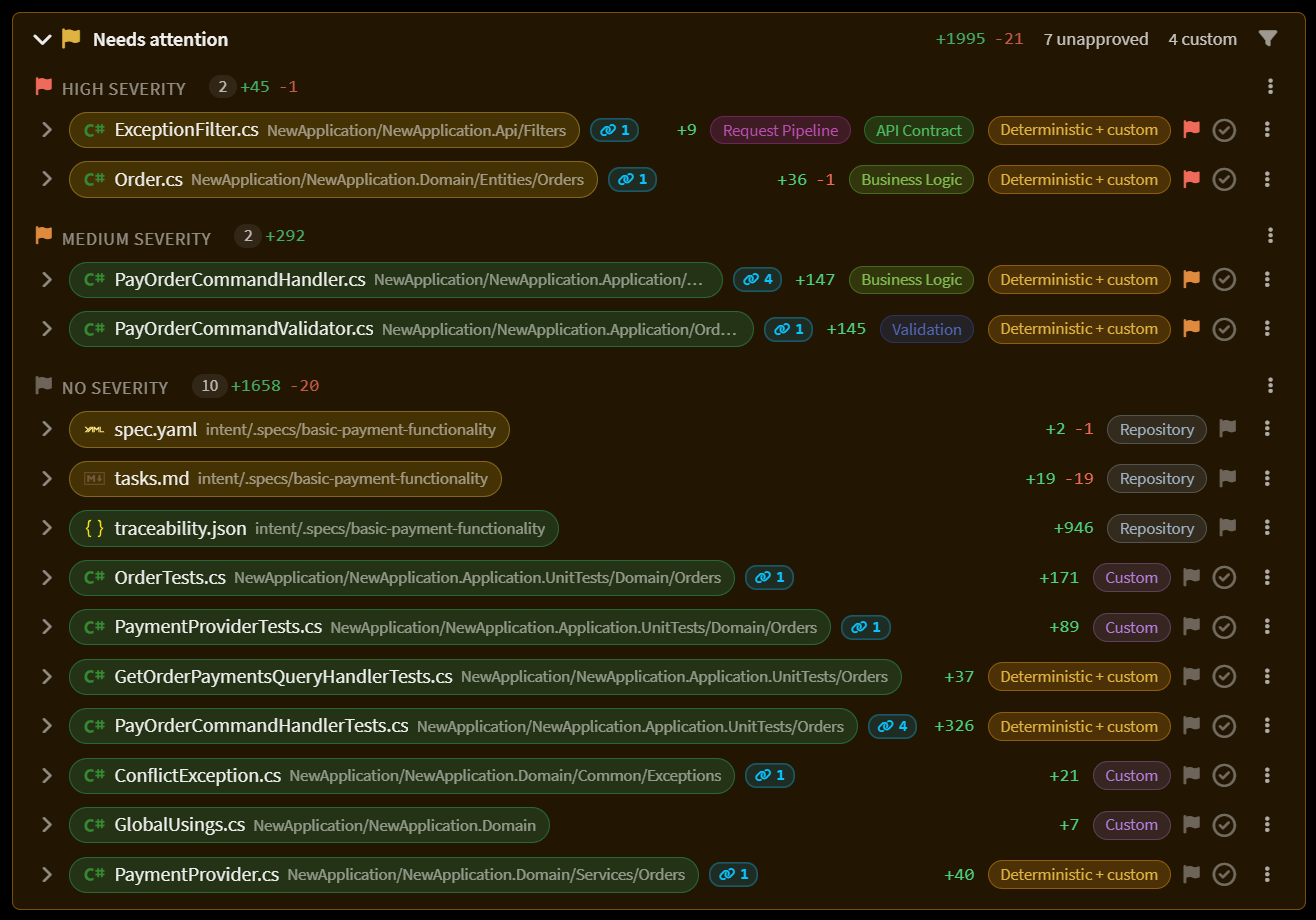
Model-centric diffs show what a change means for the design, not just the code. Hovering a change pill reveals field-level before and after values for an element or association, and reviewers can click through to the affected models to see how the domain and service models shifted.